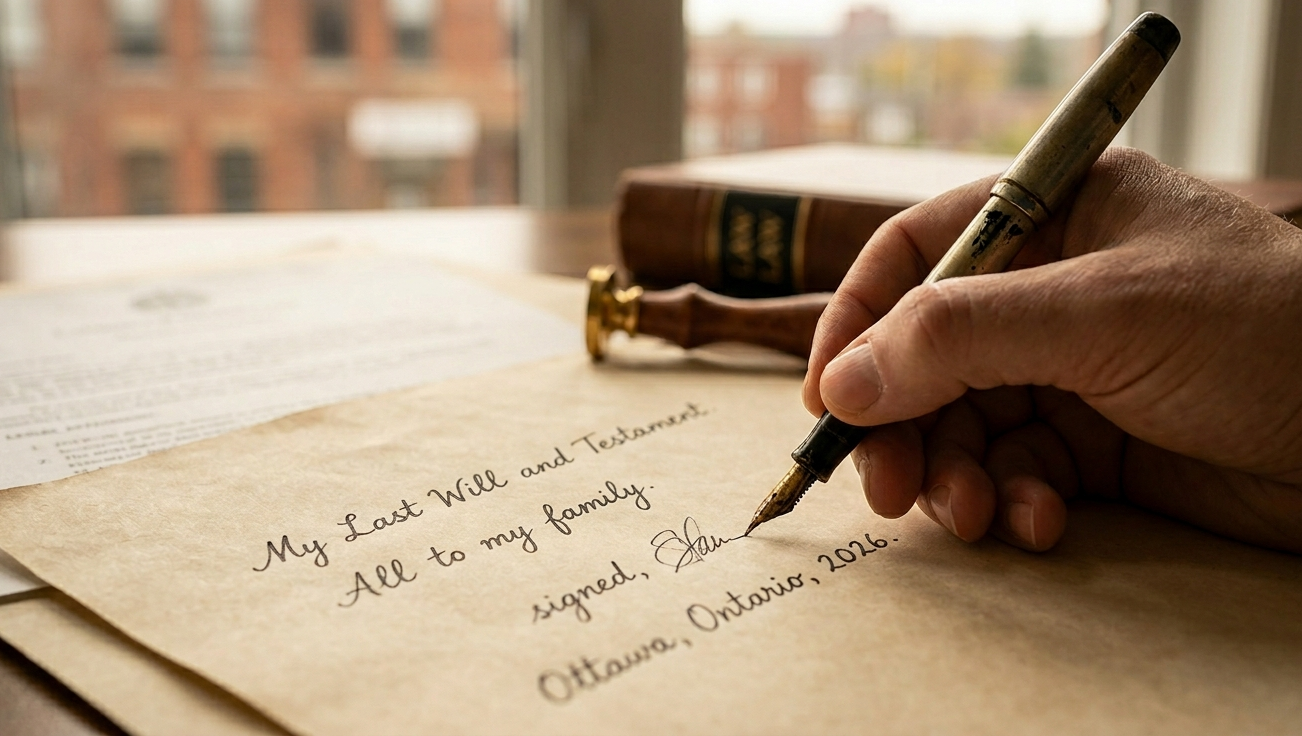
Navigating the probate process in Ontario can feel like a maze, especially when the deceased left behind a holograph will - a document written entirely in their own handwriting and signed without witnesses.
In these cases, the court requires extra assurance that the document is authentic. That is where Form 74F, Affidavit Regarding A Holograph Will or Codicil (formerly Form 74-9), becomes essential.
What is Form 74F?
Form 74F, Affidavit Regarding a Holograph Will or Codicil, is a sworn statement provided by someone who recognizes the deceased’s handwriting. Since a holograph will lacks the "Affidavit of Execution" typically provided by witnesses to a formal will, the court relies on Form 74F to verify the document's authenticity before granting a Certificate of Appointment of Estate Trustee.
Note: In older legal contexts, you may see references to Form 74-9. However, for current applications under the simplified probate rules, Form 74F is the standard.
When is Form 74F Needed?
You must file Form 74F as part of a probate application if:
- The Will is Handwritten: The document was written entirely by the deceased and is not witnessed.
- There is a Handwritten Codicil: The main will might be formal, but an amendment (codicil) was handwritten by the deceased.
- Probate is Required: The bank, Land Registry Office, or other institutions require a Certificate of Appointment to release assets.
Who Can Complete the Affidavit?
The person signing the form (the deponent) does not have to be a beneficiary or the executor. In fact, they simply need to be someone who can "authentically" recognize the handwriting. Ideal candidates include:
- Long-time friends or family members who exchanged letters with the deceased.
- Business partners or colleagues.
- Anyone who has seen the deceased sign documents or write frequently over several years.
How to Complete Form 74F: Step-by-Step Guide
Identify the Deceased
At the top of the form, you must identify the deceased by stating their full legal name. If a court file or case number has already been assigned, it should also be included.

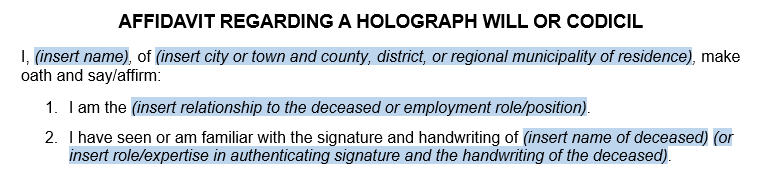
Information About the Deponent and Their Relationship With the Deceased
The person signing the affidavit must:
- State their full name and residence.
- State their relationship with the deceased and their familiarity with the deceased's signature and handwriting.
- If there were no relationship, then the deponent must confirm their expertise in authenticating signatures and handwriting.
The Verification Statement
This is the core of the affidavit. You are swearing that you have reviewed the holographic will, attached as Exhibit “A”, and that you genuinely believe the entire document, including the signature, is in the deceased’s handwriting.
The date of the holographic will and the deceased’s full legal name must be inserted in the appropriate sections of the affidavit.

Required Declarations of Eligibility and Impartiality
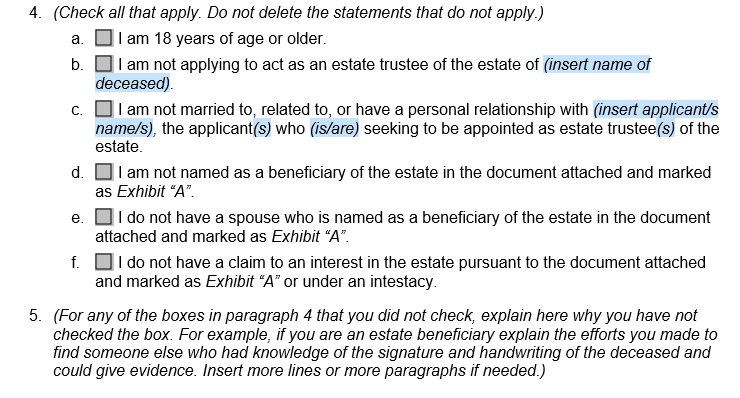
To ensure the integrity of the estate process, the person providing the affidavit (the deponent) must be entirely impartial. This means the deponent cannot have any personal or financial interest, whether direct or indirect, in the deceased’s estate.
Ineligible Individuals
The following persons are generally disqualified from making the affidavit:
- Estate Representatives: Anyone applying to act as the Estate Trustee (Executor).
- Associates of the Representative: Anyone related to, married to, or in a close personal relationship with an applicant for Estate Trustee.
- Beneficiaries: Anyone named as a beneficiary in the holographic will, or the spouse of a named beneficiary.
- Potential Heirs: Anyone claiming a legal interest in the estate, whether through the specific will or through laws of intestacy (inheritance rules when there is no will).
Quick Reference Table
| Relationship to Estate | Eligibility Status |
| Estate Trustee Applicant | ❌ Ineligible |
| Spouse/Relative of Applicant | ❌ Ineligible |
| Named Beneficiary (or Spouse) | ❌ Ineligible |
| Neutral Third Party | ✅ Eligible |
Note: If the individual stands to gain, directly or indirectly, from the distribution of the estate, they are not considered impartial and, ideally, should not sign the declaration.
To confirm impartiality, the deponent must check all applicable statements on the form. If any statement is not selected, the deponent must provide an explanation for not doing so under paragraph 5 of the form.
Under Paragraph 6 of the form, the deponent may include any additional relevant information. This can include details about the circumstances in which the holographic will was created, the deponent’s interactions with the deceased, or any experience or expertise in comparing handwriting.
Signing and Commissioning
Completing Form 74F correctly is a vital hurdle in the probate journey. While the form itself is straightforward, the evidence it provides is the bedrock of proving a handwritten will in Ontario.
Because this is a sworn legal document, it must be properly commissioned to be accepted by the Superior Court of Justice. You must sign it in the presence of a Commissioner for Taking Affidavits, a lawyer, or a Notary Public.
At NotaryServe, we specialize in helping executors and families finalize their estate documentation with precision and ease.
Contact NotaryServe to book your appointment and ensure your Form 74F is completed correctly the first time
This post is for general information only and is not legal advice. For advice specific to your situation, please contact a lawyer.